
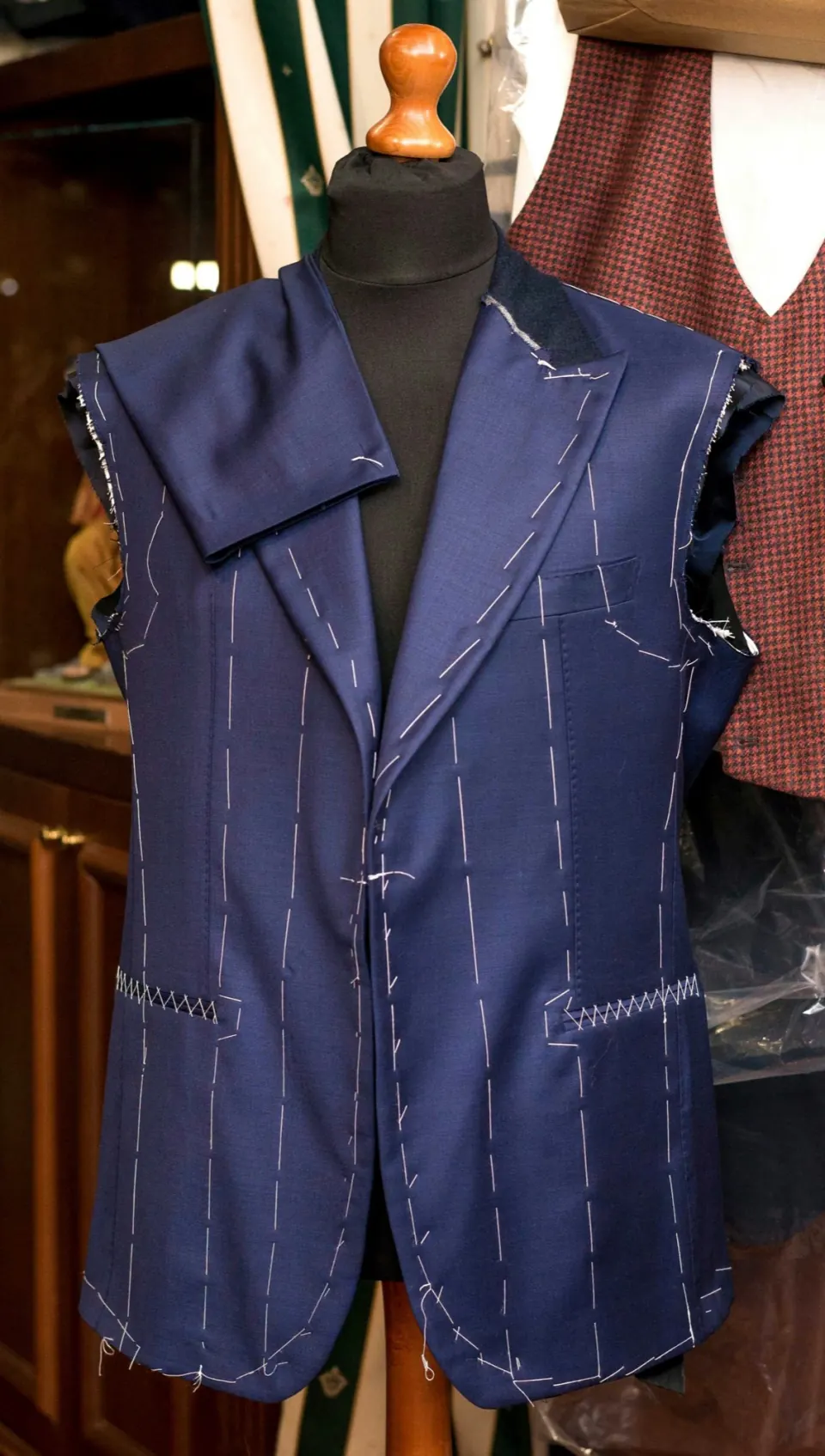
What private label means
Private label suit manufacturing means a factory produces suits that are sold under your brand. You choose the model, fabric and details; the factory makes them and adds your labels, lining, buttons and packaging. Your customers see your brand, not ours.
It sits between two other options:
| Option | Who designs | Whose brand | Typical use |
|---|---|---|---|
| Wholesale | Factory catalog | Factory or unbranded | Retailers buying ready models in lots |
| Private label | Factory base model, buyer customizes | Buyer's brand | Retail chains, online brands, wholesalers building a label |
| OEM | Buyer's own tech pack | Buyer's brand | Brands with their own design team |
Most new labels start with private label: you pick a proven base pattern from the factory and change what matters to your customer. If you already have full specifications, see OEM suit manufacturing.
What you can customize
Almost everything a customer sees or touches can carry your brand or your choice.
- Fabric: composition, weight, colour, pattern. See our fabrics page.
- Fit: slim, modern or classic, plus adjustments to jacket length, trouser rise and leg width.
- Construction: fused or half-canvas, depending on your price point.
- Lapel and style: notch, peak or shawl; single or double-breasted; 2-piece or 3-piece.
- Lining: colour, print, even a custom printed lining with your logo.
- Buttons: material, colour, engraved logo.
- Labels: main neck label, size label, care label, inside pocket label.
- Hangtags and stickers: with your barcodes and prices if you need them.
- Packaging: garment bags, hangers, boxes, carton marks.
MOQ for private label suits
At Mark Morente, private label production starts at 100 units per style. A style means one model in one fabric and colour. You can usually spread those units across your size range.
Some branding elements, such as custom woven labels, engraved buttons or printed lining, have their own minimums at the supplier level. We tell you upfront if an item needs a larger quantity.
How sampling works
Sampling is where your brand is really made. Do not rush it.
- You send the brief and references.
- The factory proposes a base model and fabric options.
- A first sample is made in your sample size.
- You fit it on a real person, not only a mannequin, and send comments.
- Corrections are made. One or two rounds is normal.
- You approve a final sample. This becomes the production standard.
We use in-house CAD pattern design and 3D prototyping, which helps keep sample rounds short. Branded labels and buttons can sometimes be shown on the sample or confirmed with photos.
Timeline
A realistic private label timeline looks like this:
| Stage | What happens |
|---|---|
| Brief and quotation | Factory confirms model, fabric, quantity and price |
| Sampling | First sample, comments, final approval |
| Trims and branding | Labels, buttons, lining and packaging ordered |
| Production | Cutting, sewing, pressing, finishing |
| Quality control | Inline and final checks against the approved sample |
| Shipping | Air, sea or road to your warehouse or forwarder |
Our production time is typically 12-15 days once fabric and trims are ready, depending on quantity, model and fabric availability. Sampling and branded trims add time before that, so plan your season backwards from your launch date.
How to brief a factory: tech pack basics
You do not need a 40-page tech pack to start. You do need to be specific. A good private label brief covers:
- Model: photos or sketches, front and back.
- Fit and measurements: a reference garment or a size chart with key points (chest, waist, jacket length, sleeve, shoulder, trouser waist, inseam).
- Size range: for example EU 44-58, plus short or long fits if needed. See our size guide.
- Fabric: composition, weight, colour code or swatch.
- Construction: fused or half-canvas, lining type, number of pockets, vents.
- Trims: button type and size, thread colour, zip type.
- Branding: label artwork with sizes and positions.
- Packing: fold or hang, polybag or garment bag, units per carton.
- Quantities: per colour and per size.
If you are unsure about any item, say so. A factory can propose options, but it cannot guess.
Common mistakes
These are the issues we see most often with new private label clients:
- Too many styles at once. Ten styles at the minimum is harder to sell than three styles with depth.
- Wrong size curve. Copying a size split from another market. A Nordic customer and a West African customer do not have the same size spread.
- Late label artwork. Production waits for labels. Send artwork with the order, not after.
- Changing fabric after sample approval. Even a similar fabric can change how the jacket falls.
- No written spec. Details agreed only on a call get lost. Put everything on the order sheet.
- Ignoring care labels. Your market may have rules on fibre composition and care labels. In the EU, for example, fibre composition labelling follows Regulation (EU) No 1007/2011.
Private label checklist
- Base model and fit chosen
- Fabric approved from swatch
- Size range and quantities per size confirmed
- Label, button and lining artwork sent
- Care and composition label text checked for your market
- Final sample approved and kept
- Packing and carton marking agreed
- Payment terms and delivery term on the proforma invoice
Building a first collection
A focused first collection is easier to produce, easier to sell and cheaper to reorder. A practical starting point for a new private label suit range:
- Two or three core colours, usually navy, charcoal and black, in one fit.
- One ceremony or wedding model, such as a 3-piece suit or a shawl-lapel tuxedo, if your customers buy for events.
- One seasonal fabric, for example a lighter cloth for summer.
Keep the same branded trims across all styles. One label design, one button and one lining colour across the range lowers trim minimums and makes reorders faster. When a style sells, reorder it in depth before adding new ones.
Reorders and consistency
The second order matters as much as the first. To keep reorders consistent, keep your approved sample, your size chart and the fabric reference together, and quote them on every order. We keep the pattern on our CAD system, so a reorder of an approved style starts from the same pattern every time.
Frequently asked questions
What is the minimum order for private label suits?
Our private label MOQ starts at 100 units per style, where a style is one model in one fabric and colour. Some custom trims may have their own minimums.
Can I use my own fabric?
Often, yes. Tell us the fabric details and quantity so we can confirm consumption and whether it suits the model.
How many sample rounds are normal?
One or two rounds is normal for a new private label suit. More rounds usually mean the brief was not clear enough at the start.
Can I order private label suits as an individual?
No. We work with businesses only, such as brands, retailers and wholesalers.